Here is a post from the website of the Free Range Farmers Association which is worth repeating:
Changes designed to water down the Model Code of Practice for the Welfare of Animals, Domestic Poultry are now being planned by the Australian Egg Corporation. It has arranged a forum to discuss the issues in Sydney on April 4 and it is vital for real Free Range farmers across Australia to have their say.
James Kellaway, AECL Managing Director, always claims that the organisation represents every industry sector when AECL actions make it clear that the Egg Corp only cares about the big operators and takes no notice of the free range sector (unless it's the intensive 'free range' version).
Help us to make your voice heard by telling us what you think about watering down the Model Code which establishes clear guidelines for the free range industry. The fundamentals of the Model Code are stocking density and beak trimming. The current Code is crystal clear on beak trimming - it must only be a last resort when other methods of controlling feather picking and cannibalism have been tried and failed. But the Egg Corporation accredits farms to it Egg Corp Assured programme when they have beak trimmed or de-beaked their birds at day old or soon after - completely contravening the Code which the Egg Corp still claims is a mandatory requirement of its accreditation scheme.
The issue of stocking density was clear to all in the industry until a couple of years ago. It stipulates a maximum outdoor stocking density of 1500 hens per hectare. But then some of the 'smart' operators felt they could exploit what they saw as a loophole and use a clause in the appendix to the Code which allows higher stocking densities for meat birds.
They claim (now supported by AECL) that this permits an unlimited number of birds and some farms are running up to 50,000 hens per hectare - all with the blessing of AECL. The Egg Corporations says it plans to close this 'loophole' by introducing its new standard (which it wants to call Egg Standards Australia) which will impose a ceiling of 20,000 hens per hectare, remove all restrictions on beak trimming and allow birds to be locked up in sheds for 25 weeks.
If you want your voice to be heard at the Egg Corp forum on the Model Code, please contact FRFA with your thoughts.
You can contact FRFA at farmers@dcsi.net.au
This fight has been ongoing for about two years and there are no signs yet that the Egg Corporation will take any notice of egg farmers - so we hope to show politicians the duplistic nature of the AECL's plans.
Saturday, February 11, 2012


Thursday, February 09, 2012
Dumb Bureaucracy!
We've been having an ongoing battle with Bass Coast Shire Council about our postal address for the last 18 months or so. Over the 30 years we have been here, our address has been Stanley Road, Grantville. But a couple of years ago the Shire decided to do some township boundry realignments and, in their wisdom, we suddenly became part of Glen Forbes.
I am contacting you as a result of difficulties you have experienced lately in having your mail delivered in a timely manner to your property. I have visited the local area in an effort to establish a resolution to this issue. As you are aware, Rural Road Numbering was implemented in your area some time ago in accordance with the state-wide Rural Addressing System. Using your address greatly assists emergency services and other utilities to find your property efficiently, including Australia Post. Although your property is within the Glen Forbes Locality it cannot be accessed by the contractor who services the Glen Forbes area. For this reason and to help us deliver your mail on time to the correct destination, it is necessary to change your postal address to a Private Bag address. This will enable our operations to be more efficient and prevent your mail being delayed.
No problems - we don't care where the Shire says we are physically located. But the mailing address is a different thing. The Shire started sending things like Rates Notices to us at Glen Forbes. The problem with that is that access to Stanley Road is from Grantville, not from Glen Forbes - so the mail was seldom (if ever) delivered if it was addressed to us at Glen Forbes. Our Bank also sent statements etc to us at Glen Forbes - none of them reached us - until we convinced the bank to change our postal address back to Grantville.
We have no idea how much mail has gone astray in the past couple of years thanks to the combined bungling of Bass Coast Shire and Australia Post !
We suggested the solution to Bass Coast Shire when this issue first arose because of their incompetence – leave our location address as Glen Forbes if that's how they get their jollies, but change our postal address back to Grantville - as that's the only way we get mail delivered.
They couldn't have cared less, even when I advised that if we didn't receive rates notices we obviously couldn't pay them. Staff weren't interested and the Shire Mayor (who happens to be our local councillor) was less than helpful.
Bureaucracy sucks.
Here's an email received today from Australia Post:
I am contacting you as a result of difficulties you have experienced lately in having your mail delivered in a timely manner to your property. I have visited the local area in an effort to establish a resolution to this issue. As you are aware, Rural Road Numbering was implemented in your area some time ago in accordance with the state-wide Rural Addressing System. Using your address greatly assists emergency services and other utilities to find your property efficiently, including Australia Post. Although your property is within the Glen Forbes Locality it cannot be accessed by the contractor who services the Glen Forbes area. For this reason and to help us deliver your mail on time to the correct destination, it is necessary to change your postal address to a Private Bag address. This will enable our operations to be more efficient and prevent your mail being delayed.
This is the solution we suggested to Shire ages ago. Leave our residential address as Glen Forbes but continue sending our mail to us at Grantville, as that is the only way it gets delivered.
It's nice to have a win now and then – but lets hope this works!!!
As for the comments about the Rural Addressing System making it easier for emergency services to find our property – how can it be more efficient to tell them that our address is Glen Forbes when the only access to the property is from Grantville? Our local CFA guys know that Stanley Road is in Grantville, not Glen Forbes, but brigades from further away wouldn't have a clue neither would the State Emergency Service, Police or Ambulance crews. So presumably they would head to Glen Forbes and then ask for directions from locals ..... so much for efficiency.
Thank you Bass Coast Shire.
Thank you Bass Coast Shire.
Wednesday, February 08, 2012
Australians are eating more eggs than ever
Australians are eating more eggs than ever according to statistics from the Australian Egg Corportion. Egg consumption is up by 7% from 198 per person in 2010 to 213 last year.
The egg industry produced 392 million dozen eggs last year - 12.9 million each day. This figure is 10% higher than 2010 levels and represents a 51% increase since 2000.
More info at
http://www.foodprocessing.com.au/news/51081-Australian-egg-industry-is-a-cracker-report
The egg industry produced 392 million dozen eggs last year - 12.9 million each day. This figure is 10% higher than 2010 levels and represents a 51% increase since 2000.
More info at
http://www.foodprocessing.com.au/news/51081-Australian-egg-industry-is-a-cracker-report
Thursday, February 02, 2012
Egg Corp's plans are unravelling
There's a good piece about the problems in the egg industry on the Sustainable Table website at:
http://www.sustainabletable.org.au/TableTalk/tabid/53/EntryId/36/The-Free-Range-Controversy.aspx
This is on top of AECL calling an emergency meeting of the 25 biggest egg producers to discuss a looming over supply of eggs which is expected to hit more than one million eggs a day by July unless the size of the national flock is reduced.
The Egg corp still hasn't been able to push through its new standard for intensive 'free range' production.
http://www.sustainabletable.org.au/TableTalk/tabid/53/EntryId/36/The-Free-Range-Controversy.aspx
This is on top of AECL calling an emergency meeting of the 25 biggest egg producers to discuss a looming over supply of eggs which is expected to hit more than one million eggs a day by July unless the size of the national flock is reduced.
The Egg corp still hasn't been able to push through its new standard for intensive 'free range' production.
Monday, January 30, 2012
Egg Corp crisis meeting
The Australian Egg Corporation has called a crisis meeting for early February to get the biggest 25 egg producers to address the problems of massive over-supply.
http://www.abc.net.au/rural/news/content/201201/s3418596.htm
Apparently by July this year, on current projections more than one million eggs will be laid each day than can be sold in Australia. One of the Egg Corp's solutions - kill half a million birds.
Hmmm !!!
http://www.abc.net.au/rural/news/content/201201/s3418596.htm
Apparently by July this year, on current projections more than one million eggs will be laid each day than can be sold in Australia. One of the Egg Corp's solutions - kill half a million birds.
Hmmm !!!
Backyarders now blamed for egg industry woes
The Australian Egg Corporation says that backyard flocks now account for about 12% of egg production in Australia. The reality is people have always had chooks - but the numbers are now growing because the community is fed up with the dishonesty of producers who mislabel their eggs.
Customers aren't stupid, they know that the Egg Corp allows intensively-farmed eggs go be labelled as 'free range' and that this situation will be even worse if the new standard is pushed through which endorses a proposed stocking density of up to 20,000 hens per hectare.
It was a great talking point at Farmers' Markets over the weekend - particularly at Churchill Island and Inverloch.
Customers aren't stupid, they know that the Egg Corp allows intensively-farmed eggs go be labelled as 'free range' and that this situation will be even worse if the new standard is pushed through which endorses a proposed stocking density of up to 20,000 hens per hectare.
It was a great talking point at Farmers' Markets over the weekend - particularly at Churchill Island and Inverloch.
Friday, January 27, 2012
Diatomacious Earth good for lice and mite control on chickens
I've been asked about Diatomacious Earth, as I've included it as a parasite control in my ebook on keeping chickens.
It's very useful substance, a light, powdery rock formed in the Jurassic period from fossilised algae. The insecticidal properties it has have nothing to do with chemicals - it is simply very absorbant so it dries out little insects and dehydrates them.
Sprinkle a little in nest boxes or in dust bathing areas and say goodbye to mites and lice. It can also be used a slurry to paint on perches if you notice a mite invasion.
Best to buy a food grade version because obviously the chooks may eat it. The product is used widely in things like cat litter as an absorbent, and for mopping up industrial spills (including major oil spills).
It's a very fine powder, so sprinkle it where you need it: In your chicken nests, on the perches and around the feed bins. You can also use it for cockroach and other insect control in the home – but because it is so fine, wear a mask when using it.
Please only use food grade diatomaceous earth for your flock and your household, as other grades can contain chemicals and high amounts of crystalline silica which can damage your lungs.
It's very useful substance, a light, powdery rock formed in the Jurassic period from fossilised algae. The insecticidal properties it has have nothing to do with chemicals - it is simply very absorbant so it dries out little insects and dehydrates them.
Sprinkle a little in nest boxes or in dust bathing areas and say goodbye to mites and lice. It can also be used a slurry to paint on perches if you notice a mite invasion.
Best to buy a food grade version because obviously the chooks may eat it. The product is used widely in things like cat litter as an absorbent, and for mopping up industrial spills (including major oil spills).
Food grade diatomaceous earth is a natural pest deterrent that is safe for you, your chickens, and other pets. It helps to keep your flock healthy by killing ticks, fleas, and digestive worms.
How to use it:It's a very fine powder, so sprinkle it where you need it: In your chicken nests, on the perches and around the feed bins. You can also use it for cockroach and other insect control in the home – but because it is so fine, wear a mask when using it.
Please only use food grade diatomaceous earth for your flock and your household, as other grades can contain chemicals and high amounts of crystalline silica which can damage your lungs.
Wednesday, January 25, 2012
Australian Egg Corporation hits the panic button - 5 million dozen eggs in storage
This is from the latest newsletter of the Australian Egg Corporation and it demonstrates what a spin they are in.
Egg Corp layer and egg supply forecastThe forecast report for January has been distributed by AECL to all egg producer subscribers to the service. It paints a daunting picture of record and increasing egg supplies to the market given the chicks that have already been placed and those now on order. Production is now projected to reach 34 million dozen in July this year. It says that action is needed by all egg producers to control the oversupply or surplus. The best indicator is your coolroom and the increasing stocks in inventory. The inventory report suggests that inventory levels are now at record volumes, in excess of 5 million dozen.
Given the significant and now record levels of egg production and egg inventory, AECL has requested a meeting of the top 25 egg producers to seek a ‘path forward’ for the egg industry in a co-ordinated and consolidated fashion to ensure its profitable sustainability, a key part of the egg industry’s vision. All other egg producers are welcome to join the meeting that will take place in Sydney during early February.
The huge volumes of surplus eggs demonstrate why there is such pressure to allow intensively produced eggs to be labelled as 'free range'. There is now a real dilemma amongst the big producers as they all thought the new slack standards would be through now to get them out of trouble.
Egg Corp layer and egg supply forecastThe forecast report for January has been distributed by AECL to all egg producer subscribers to the service. It paints a daunting picture of record and increasing egg supplies to the market given the chicks that have already been placed and those now on order. Production is now projected to reach 34 million dozen in July this year. It says that action is needed by all egg producers to control the oversupply or surplus. The best indicator is your coolroom and the increasing stocks in inventory. The inventory report suggests that inventory levels are now at record volumes, in excess of 5 million dozen.
Given the significant and now record levels of egg production and egg inventory, AECL has requested a meeting of the top 25 egg producers to seek a ‘path forward’ for the egg industry in a co-ordinated and consolidated fashion to ensure its profitable sustainability, a key part of the egg industry’s vision. All other egg producers are welcome to join the meeting that will take place in Sydney during early February.
The huge volumes of surplus eggs demonstrate why there is such pressure to allow intensively produced eggs to be labelled as 'free range'. There is now a real dilemma amongst the big producers as they all thought the new slack standards would be through now to get them out of trouble.
Sunday, January 22, 2012
50,000 hits on the Freeranger blog
I noticed on the blogger stats this morning that this site has just reached 50,000 page views. The most popular posts are 'Why hens stop laying' and our 'So you want to keep chickens?'
We are pleased that so many people find this site useful, particularly with so much misleading information being peddled by the Australian Egg Corporation about its new standards for 'free range' production.
We are pleased that so many people find this site useful, particularly with so much misleading information being peddled by the Australian Egg Corporation about its new standards for 'free range' production.
Monday, January 16, 2012
Runny egg whites

If an egg is broken onto a flat surface and the albumen (white) is watery and spreads-out, this may indicate that the egg is stale - but there can be other reasons. The height of the albumen and the weight of the egg are used to calculate a value in Haugh units on a scale of 0 to 110. Under this measuring system, the lower the value, the staler the egg is supposed to be.
A minimum Haugh unit measurement of 60 is desirable for whole eggs sold to domestic consumers. Eggs leaving the farm should average between 75 and 85 Haugh units and many farms conduct random testing to ensure that this quality standard is met.
Although watery whites are thought to be mainly an indication of the increasing age of the egg, the problem can be exacerbated by high storage temperatures and low humidity. Also, as birds age, the Haugh unit value of their eggs decreases by about 1.5 to 2 units per month of lay. Some birds consistently produce eggs with watery whites (Haugh units less than 30) later in lay, which is one reason that most commercial farms only keep their birds for one laying season.
Here are some steps eggs farmers take to minimise the problems of watery whites:
Keep the flock age as low as possible;
Collect eggs several times each day and store at correct temperature – less than 20ºC;
Grade, pack and despatch eggs to customers as quickly as possible;
During grading, remove all eggs with rough, porous shells and/or large air cells;
Consider fitting a humidifier in the coolroom to maintain storage humidity at 70 - 80%;
Maintain good disease control, particularly with correct vaccinations;
Ensure there are no fungal toxins in feed (don't use wet or mouldy feed);
Eliminate rough handling;
Pack eggs on filler flats or in cartons with the air cell (blunt end) upwards.
Excluding disease, the single most important factor affecting the albumen quality of freshly laid eggs is the age of the birds. With advancing flock age, Haugh unit scores decrease and the variability of the scores increases. An induced pause in egg production (moult) can often restore albumen quality in aging hens. Both strain differences and strain/age interaction effects in Haugh unit scores of fresh eggs have often been observed, but these are normally small and have little practical significance. Albumen quality of the egg is not greatly influenced by bird nutrition. .
When ambient temperatures are high, delays in egg collection increase the rate of Haugh unit score decline. The maintenance of albumen quality during egg storage is dependent on the eggs being cooled quickly following lay and subsequently being held at low temperatures.
Different strains of hens can show a great variation in Haugh unit scores. Strains laying white-shelled eggs have been shown to be much less variable than those producing brown-shelled eggs.
Excluding disease, the single most important factor affecting the albumen quality of freshly laid eggs is the age of the birds. With advancing flock age, Haugh unit scores decrease and the variability of the scores increases. An induced pause in egg production (moult) can often restore albumen quality in aging hens. Both strain differences and strain/age interaction effects in Haugh unit scores of fresh eggs have often been observed, but these are normally small and have little practical significance. Albumen quality of the egg is not greatly influenced by bird nutrition. .
When ambient temperatures are high, delays in egg collection increase the rate of Haugh unit score decline. The maintenance of albumen quality during egg storage is dependent on the eggs being cooled quickly following lay and subsequently being held at low temperatures.
Different strains of hens can show a great variation in Haugh unit scores. Strains laying white-shelled eggs have been shown to be much less variable than those producing brown-shelled eggs.
Saturday, January 14, 2012
Churchill Island Farmers' Market
It was an excellent day at Churchill Island Farmers' Market today. I sold out all my eggs at about noon - 150 dozen. Now we have to prepare for the Inverloch Farmers' Market tomorrow.
We don't normally do two markets on a weekend because we don't usually have enough eggs. But because of the abnormally cool weather for midsummer, the chooks are still laying brilliantly and we have a great lay rate.
This, coupled with a slack economy which means that the restaurant trade is down about 25% compared with this time last year, allows us go to more markets.
In fact this weekend we have three! Anne went to the Coal Creek Farmers' Market and sold around 80 dozen.
So assuming Inverloch is successful, we should end up having a great weekend.
Hopefully it will make up for last Wednesday when I went to the market at Venus Bay. The weather was atrocious, virtually no customers came along and most stall holders went home after an hour or so.
I stuck it out in the wind for a while, but eventually gave up and headed back to the farm. I sold just 13 dozen !!
We don't normally do two markets on a weekend because we don't usually have enough eggs. But because of the abnormally cool weather for midsummer, the chooks are still laying brilliantly and we have a great lay rate.
This, coupled with a slack economy which means that the restaurant trade is down about 25% compared with this time last year, allows us go to more markets.
In fact this weekend we have three! Anne went to the Coal Creek Farmers' Market and sold around 80 dozen.
So assuming Inverloch is successful, we should end up having a great weekend.
Hopefully it will make up for last Wednesday when I went to the market at Venus Bay. The weather was atrocious, virtually no customers came along and most stall holders went home after an hour or so.
I stuck it out in the wind for a while, but eventually gave up and headed back to the farm. I sold just 13 dozen !!
Friday, January 13, 2012
Year of the Farmer
This year, 2012, is dedicated in Australia to primary producers and a special Year of the Farmer program will celebrate the contribution farmers and rural communities make to the nation.
Activities will run for the next 12 months, with events planned along the way, with the aim of broadening public awareness of the wider farming industry With support from sponsors and ambassadors such as cricketer, Glenn McGrath, the events will focus on heightening consumer appreciation and understanding of Australian produce.
A rolling event is the AustralianYear of the Farmer Roadshow, which will travel more than 55,000 km across Australia to 300 event days in all states and territories, appearing at agricultural field days, expos, concerts, rodeos, festivals and shows.
The roadshow will help Australians celebrate the important role farming plays in all our lives. Here at Freeranger Eggs, we recognise the importance of informing the community about the way farming impacts on allof us. Which is why we have been so active pushing for honesty about production methods and the need for Truth in Labelling legislation.
Activities will run for the next 12 months, with events planned along the way, with the aim of broadening public awareness of the wider farming industry With support from sponsors and ambassadors such as cricketer, Glenn McGrath, the events will focus on heightening consumer appreciation and understanding of Australian produce.
A rolling event is the AustralianYear of the Farmer Roadshow, which will travel more than 55,000 km across Australia to 300 event days in all states and territories, appearing at agricultural field days, expos, concerts, rodeos, festivals and shows.
The roadshow will help Australians celebrate the important role farming plays in all our lives. Here at Freeranger Eggs, we recognise the importance of informing the community about the way farming impacts on allof us. Which is why we have been so active pushing for honesty about production methods and the need for Truth in Labelling legislation.
Thursday, January 12, 2012
Australian Egg Corp caught with its pants down
Here's a great response to the Australian Egg Corporation's attempt to con politicians and consumers about its 'view' of the industry and its plans.
http://humanechoice.com.au/Resources/Documents/AECL%20High%20Politics%20and%20Low%20Blows%20-%20Propegganda.pdf
http://humanechoice.com.au/Resources/Documents/AECL%20High%20Politics%20and%20Low%20Blows%20-%20Propegganda.pdf
Tuesday, January 03, 2012
What a trusting young dog !!

Why would a dog think it was comfortable to go to sleep with his head on the bottom pad of an ironing press? He clearly hasn't watched The Three Stooges!
This is Wesson, our Smithfield/Dingo/ Kelpie cross, born with no tail and all he wants to do at night is sleep indoors with us (preferably on the bed).
He's the sort of dog that has only two speeds - asleep/motionless or flat-out running, bouncing and barking like a banshee.
Back on line after a lightning strike
Our phone land line (and therefore internet connection) was knocked out by lightning on Christmas Eve and when I contacted our service provider - DCSI - they advised that Telstra was contracted to carry out line servicing and maintenance for them.
The problem with that was that Telstra said they couldn't come to the farm to look at the problem (and hopefully fix it) until January 3(today).
As you can tell, the line is now fixed - but how did Telstra and DCSI expect us to carry out our normal business activites without a phone or internet access for 10 days?
At this time of year, peak holiday season, all our restaurants need more eggs and they ring or email their orders on a regular basis. Thankfully most of our regulars have my mobile number but we missed orders from those shops and restaurants which only deal with us occasionally.
I don't understand what would have been hard for the landline calls to be switched to my mobile given that Telstra couldn't be bothered to fix the line in a day or so.
I've advised DCSI that we will lodge a complaint with the Telecommunications Ombudsman.
The problem with that was that Telstra said they couldn't come to the farm to look at the problem (and hopefully fix it) until January 3(today).
As you can tell, the line is now fixed - but how did Telstra and DCSI expect us to carry out our normal business activites without a phone or internet access for 10 days?
At this time of year, peak holiday season, all our restaurants need more eggs and they ring or email their orders on a regular basis. Thankfully most of our regulars have my mobile number but we missed orders from those shops and restaurants which only deal with us occasionally.
I don't understand what would have been hard for the landline calls to be switched to my mobile given that Telstra couldn't be bothered to fix the line in a day or so.
I've advised DCSI that we will lodge a complaint with the Telecommunications Ombudsman.
Friday, December 23, 2011
Woolworths in South Africa have been a little misleading!
Have a look at this from South Africa. http://www.health24.com/dietnfood/Food_journey/15-2052-2946,72107.asp
Things aren't much different hey !!
Things aren't much different hey !!
Thursday, December 22, 2011
Rates notice saga continues
The saga of our rates from Bass Coast Shire looks likely to continue for a while. I had another 'phone conversation with another lady from the Shire today.
Apparently the Shire data bank has our property listed as being in Glen Forbes (which is fine, I don't give a hoot where they say the property is). But I couldn't get an explanation from her why they can't send the rates notice to our postal address - which is Grantville.
Not hard I would have thought!
Apparently the Shire data bank has our property listed as being in Glen Forbes (which is fine, I don't give a hoot where they say the property is). But I couldn't get an explanation from her why they can't send the rates notice to our postal address - which is Grantville.
Not hard I would have thought!
Wednesday, December 21, 2011
Bass Coast Shire rates notice stuff-up
It's that time of year when council rates notices are sent out and it's always interesting seeing how much the local council wants to take out of our pockets. But this year we don't know - yet. Here in Bass Coast Shire we don't get much for our rates - so maybe this year they've decided to give our farm a rate holiday.
The rates notice hasn't arrived! Unfortunately I don't think they are being generous. Last year, for some inexplicable reason, they decided that our rates notices should be sent to Stanley Road, Glen Forbes (which doesn't exist) instead of our real address in Grantville with a 3984 postcode.
I had a conversation today with a very pleasant lady from the Shire - but it didn't resolve anything. Why on earth do they have to fiddle. Grantville has been our address for around 30 years. But we are happy not to receive rates notices - as long as they don't expect any penalties for late payment.
Wonder how long this will take to sort out !!!!
The rates notice hasn't arrived! Unfortunately I don't think they are being generous. Last year, for some inexplicable reason, they decided that our rates notices should be sent to Stanley Road, Glen Forbes (which doesn't exist) instead of our real address in Grantville with a 3984 postcode.
I had a conversation today with a very pleasant lady from the Shire - but it didn't resolve anything. Why on earth do they have to fiddle. Grantville has been our address for around 30 years. But we are happy not to receive rates notices - as long as they don't expect any penalties for late payment.
Wonder how long this will take to sort out !!!!
Enforcement of European cage laws may begin in the New Year
THIRTEEN member states have been warned they face legal action because of their failure to comply with the imminent EU barren battery cage egg ban.
EU Health Commissioner John Dali has told Members of the European Parliament (MEPs) that letters have already been sent to those member states that have made ‘little or no effort’ to conform to the new laws, informing them they will be taken to court.
Mr Dalli also confirmed that Commission inspection teams are ready to go ‘all out’ from January 1, when the ban on conventional cages comes in, to collect the evidence of non compliance to back up prosecutions when they go to court.
The 13 member states already in breach of new rules are: Hungary, Italy, Latvia, Spain, Greece, Belgium, Bulgaria, Cyprus, Poland, Portugal, Romania, Slovakia and the Netherlands.
The European Commission has been heavily criticised for its failure to take firmer action to force member states to comply with the ban and to prevent trade in illegally produced eggs between member states after January 1.
Scottish Liberal Democrat MEP George Lyon welcomed comments by the Commissioner at a recent meeting.
Mr Lyon said Mr Dalli had given him a guarantee that there would be no extension of the January 1 deadline, no derogations and ‘no escape route for those who have failed to comply’.
“I was pleased to hear that infringement procedures have already been started against member states that have chosen to flout the law and that EU inspectors are poised ready to gather evidence against them from the start of 2012,” he said.
“I hope the tough action he is taking will send a message to those countries who think that they can get off the hook by turning a blind eye that they better think again and get their hen houses in order.”
The UK Government has also been criticised for not doing more to protect domestic producers from illegally produced egg imports. Farming Minister Jim Paice said earlier this month that the UK could not enforce a unilateral ban due to the ‘very significant legal and practical implications’ and practical difficulties in implementing it.
Instead the UK will be relying largely on a voluntary food industry ban to keep illegal produce out of the country, or at least force them into the lower value processing sector.
Mr Lyon urged the Commission to ‘back to the hilt’ countries like the UK who he said are using ‘every means at their disposal to try and ban illegally produced eggs from entering their markets’.
“If that type of action is taken by all countries that are compliant it should hit hard at the pockets of illegal producers and force them to get out or upgrade,” he said.
NFU Scotland vice president of John Picken was unimpressed by the Commission’s belated actions of ‘sending letters and preparing teams to go out for inspection after the deadline has passed’. He called on the Commission and the UK Government to take a ‘stronger stance’ on enforcement of the regulations.
“We are days away from Scottish producers finding themselves at a competitive disadvantage as a result of complying with standards set by Europe. And once again the deeply disappointing message to industry is that Commission deadlines, and threats of infringement proceedings, are largely ineffectual,” he said.
“Scottish farmers who have complied in good faith ahead of the deadline face a competitive disadvantage, having borne the significant cost of moving to an enriched cage, barn or free range system.”
EU Health Commissioner John Dali has told Members of the European Parliament (MEPs) that letters have already been sent to those member states that have made ‘little or no effort’ to conform to the new laws, informing them they will be taken to court.
Mr Dalli also confirmed that Commission inspection teams are ready to go ‘all out’ from January 1, when the ban on conventional cages comes in, to collect the evidence of non compliance to back up prosecutions when they go to court.
The 13 member states already in breach of new rules are: Hungary, Italy, Latvia, Spain, Greece, Belgium, Bulgaria, Cyprus, Poland, Portugal, Romania, Slovakia and the Netherlands.
The European Commission has been heavily criticised for its failure to take firmer action to force member states to comply with the ban and to prevent trade in illegally produced eggs between member states after January 1.
Scottish Liberal Democrat MEP George Lyon welcomed comments by the Commissioner at a recent meeting.
Mr Lyon said Mr Dalli had given him a guarantee that there would be no extension of the January 1 deadline, no derogations and ‘no escape route for those who have failed to comply’.
“I was pleased to hear that infringement procedures have already been started against member states that have chosen to flout the law and that EU inspectors are poised ready to gather evidence against them from the start of 2012,” he said.
“I hope the tough action he is taking will send a message to those countries who think that they can get off the hook by turning a blind eye that they better think again and get their hen houses in order.”
The UK Government has also been criticised for not doing more to protect domestic producers from illegally produced egg imports. Farming Minister Jim Paice said earlier this month that the UK could not enforce a unilateral ban due to the ‘very significant legal and practical implications’ and practical difficulties in implementing it.
Instead the UK will be relying largely on a voluntary food industry ban to keep illegal produce out of the country, or at least force them into the lower value processing sector.
Mr Lyon urged the Commission to ‘back to the hilt’ countries like the UK who he said are using ‘every means at their disposal to try and ban illegally produced eggs from entering their markets’.
“If that type of action is taken by all countries that are compliant it should hit hard at the pockets of illegal producers and force them to get out or upgrade,” he said.
NFU Scotland vice president of John Picken was unimpressed by the Commission’s belated actions of ‘sending letters and preparing teams to go out for inspection after the deadline has passed’. He called on the Commission and the UK Government to take a ‘stronger stance’ on enforcement of the regulations.
“We are days away from Scottish producers finding themselves at a competitive disadvantage as a result of complying with standards set by Europe. And once again the deeply disappointing message to industry is that Commission deadlines, and threats of infringement proceedings, are largely ineffectual,” he said.
“Scottish farmers who have complied in good faith ahead of the deadline face a competitive disadvantage, having borne the significant cost of moving to an enriched cage, barn or free range system.”
Monday, December 19, 2011
FRFA response to Egg Corp's carbon claims
The Free Range Farmers Association agrees with the Australian Egg Corporation that eggs have a lower carbon footprint that any other source of protein, but points out the inaccuracy of assertions that cage egg production is more carbon friendly than free range production.
It has not revealed any information about the carbon footprint of the infrastructure on intensive farms – the hundreds of cubic metres of concrete, massive shedding etc., or the costs of transporting feed grain from interstate and the transport costs of sending eggs all over Australia.
Grain consumption, energy inputs and transport costs are recognised as the main contributors to the carbon footprint of the egg industry.
The Australian Egg Corporation claims that data prepared for it by consultants, using figures from three egg producers, shows that free range egg production has a higher carbon footprint that cage production – but it does not have the facts to back up this assertion.
It has not revealed any information about the carbon footprint of the infrastructure on intensive farms – the hundreds of cubic metres of concrete, massive shedding etc., or the costs of transporting feed grain from interstate and the transport costs of sending eggs all over Australia.
It has has based its claims on a desk-top review of three selected egg farms in an effort to discredit the free range egg industry.
However, a two year sustainability study of five free range egg farms in the Port Phillip & Westernport Catchment Management Authority area of Victoria showed clearly that feed input costs decreased with lower stocking densities.
One outcome from the nutrient balance figures obtained in that study was that feed consumption increased with stock density. This implied that reliance upon pasture as a feed source decreased as stock density increased.
This table demonstrated the comparative feed inputs.
-
Lay rateFeed consumptionStocking rateGrantville70%26kg/hen/yr9 DSE/haLabertouche65%35kg/hen/yr30 DSE/haPoowong80%45kg/hen/yr44 DSE/haMyrniong65%48kg/hen/yr75 DSE/ha
With a stocking rate of 9 DSE (Dry Sheep Equivalent), feed input was just 26kg a year per hen - about 70 grams of feed a day. With a stocking rate of 75 DSE, feed input almost doubled to 48 kg – about 130 grams per day.
The Australian Egg Corporation allows stocking densities on its accredited 'free range' farms of over 300 DSE.
The study was conducted by an independent agronomist for the Free Range Farmers Association and was funded by the Federal Government's Envirofund program.
Saturday, December 17, 2011
Egg Corp carbon claims don't add up
The AECL claims that new research suggests that freerange egg production has a higher carbon footprint than cage egg production. We all agree that eggs provide the lowest carbon footprint of all the main protein foods. Egg Corp Managing Director, James Kellaway, said the research was another good reason for consumers to include eggs as part of their daily diet.
“This study has highlighted some surprising results, including suggesting that the humble egg is now the highest quality protein food with the lowest emissions.
But the research also highlighted that there is still scope for refinements to current practices in egg production to allow further reductions in emissions.
AECL wishes to conduct further studies on this important topic,” Mr Kellaway said.
“With greenhouse gas (GHG) emissions front of mind for many, this research provides consumers with the information they need to help reduce their carbon footprints when buying foods,” he said.
The research project, conducted by Steve Wiedemann and Eugene McGahan (and commissioned by AECL), used Life Cycle Assessment to study the GHG emissions from three egg farms over one year.
The researchers also found that:
For a copy of the research, please contact AECL Communications Manager, Kai Ianssen, on (02) 9409 6909 or kai@aecl.org.
This was a desk-top review of existing data and did not involve any new research. Previous findings have demonstrated clearly that grain feed consumption increases significantly as stocking density increases. So of course highly intensive farms - which are almost certainly the type selected for this 'research' will have demonstrated a high carbon footprint. The intensive farms are more likely to bring feed in from interstate, and will also transport their eggs over vast distances - increasing their emissions compared with traditional free range farms which are more likely to utilise local feed supplies and distribute their eggs within the local region.
“This study has highlighted some surprising results, including suggesting that the humble egg is now the highest quality protein food with the lowest emissions.
But the research also highlighted that there is still scope for refinements to current practices in egg production to allow further reductions in emissions.
AECL wishes to conduct further studies on this important topic,” Mr Kellaway said.
“With greenhouse gas (GHG) emissions front of mind for many, this research provides consumers with the information they need to help reduce their carbon footprints when buying foods,” he said.
The research project, conducted by Steve Wiedemann and Eugene McGahan (and commissioned by AECL), used Life Cycle Assessment to study the GHG emissions from three egg farms over one year.
The researchers also found that:
- Cage production delivered a lower carbon footprint than free range egg production
- Greenhouse gas emissions from cage egg production was 1.3kg of CO2-e per kg of eggs (carbon dioxide equivalence, including methane and nitrous oxide)
- Emissions from free range egg production was found to be 1.6kg of CO2-e per kg of eggs
- Australian egg production had a lower carbon footprint than several European egg studies (mainly due to the more efficient grain production in Australia)
- The largest carbon impacts in the supply chain were: feed grain production, then manure management and energy use at the layer farm
- Free range egg production’s carbon footprint was found to be about 20% higher than caged production due to the fact that it uses more feed per kilogram of eggs produced compared to the feed efficiencies of cage egg production.
For a copy of the research, please contact AECL Communications Manager, Kai Ianssen, on (02) 9409 6909 or kai@aecl.org.
This was a desk-top review of existing data and did not involve any new research. Previous findings have demonstrated clearly that grain feed consumption increases significantly as stocking density increases. So of course highly intensive farms - which are almost certainly the type selected for this 'research' will have demonstrated a high carbon footprint. The intensive farms are more likely to bring feed in from interstate, and will also transport their eggs over vast distances - increasing their emissions compared with traditional free range farms which are more likely to utilise local feed supplies and distribute their eggs within the local region.
Thursday, December 15, 2011
Sustainable food directory planned for Australia
A directory of sustainable food producers in Australia, including Farmers Markets etc will be up an running from February. Here's a link to the project.
http://www.localharvest.org.au/
http://www.localharvest.org.au/
Wednesday, December 14, 2011
Feature on Voiceless in the Sydney Morning Herald
This feature about the organisation Voiceless is worth looking at:
https://www.voiceless.org.au/crm/sites/all/modules/civicrm/extern/url.php?u=2155&qid=424685
https://www.voiceless.org.au/crm/sites/all/modules/civicrm/extern/url.php?u=2155&qid=424685
Sunday, December 11, 2011
Times of India rant on 'free range' eggs
Here's a piece from the Economic Times, the Sunday supplement of the Times of India. They don't like what's happening to their egg industry either!!!!!
http://economictimes.indiatimes.com/articleshow/11063496.cms
http://economictimes.indiatimes.com/articleshow/11063496.cms
Friday, December 09, 2011
Closure of an abattoir in gippsland
Here's a plea from a mate, Gordon Rouse, about the way a small family-owned abattoir was closed down because of the totaly illegal and unacceptable actions of one employee.
Last week saw the free-range animal industry in Victoria take a huge beating. The tragedy began when an abattoir worker in Trafalgar broke the trust invested in him by 'torturing' a pig.
The ordeal could have easily ended there, with worker dissmissed and charged for cruelty to animals, and the abattoir owner paying a fine (a donation to an animal charity) for failing in their duty as managers. Such an outome would have been just and fair in most peoples eyes. Instead, the abattoir has been forced to close, terminating the employment of all its staff and putting the livelihoods of several small free-range producers, and local businesses at stake.
On Saturday 3rd of December, the CEO of Primesafe was quoted as saying he would shut down the business, even though the investigation his company was conducting was imcomplete. A few days later, the abattoir owners relinquished their licences and the business was closed indefinitely. While the family owners cannot comment on what made them choose to relinquish their license, CEO of Primsafe - Brian Casey was quite happy to deny any responsibility in forcing the business to close when interviewed on the 7:30 report.
Based on comments made earlier, the closing of the abattoir was certainly an outcome Primesafe desired.
Why would Primsafe desire such an outcome?
A few weeks ealier we read in the paper about a chicken processing plant in eastern Melbourne, where chicken carcasses were being innapropriately stored, workers were getting injured and killed, and casual labourers being grossly underpaid. When did Primsesafe CEO Brian Casey make a statement that this factory ought to be closed?
If local food is to remain viable, we need small abattoirs that service the direct-to-consumer meat industry. Naturally we want these abattoirs to operate humanely, but they need to be given as much right to a second chance as larger abattoirs. Shutting down small abattoirs is a step backwards for the humane treatment of animals and a blow in the head for local food.
If you want to support the family and the town of Trafalgar, you can register yourself as a member of the facebook group "Community support for LE Giles & sons". I warn you that some views expressed on this page are regrettable, but should be seen in the light of the anger the abattoirs closure has caused.
You may wish also write to local Victorian state members of parliament.
There are two aspects to this issue that should warrant review:
1./ The action of Primesafe CEO Brian Casey in making comments while the matter was under investigation, a luxury not available to the business owners.
2./ The non-transparent nature by which a business is forced to reliquish its abattoir license.
Seeing past the issue of animal cruelty is an issue of injustice to a local community and the destruction of a decent food industry. The actions of Primesafe have punished the innocent with the guilty, and surely this a grave injustice also?
Last week saw the free-range animal industry in Victoria take a huge beating. The tragedy began when an abattoir worker in Trafalgar broke the trust invested in him by 'torturing' a pig.
The ordeal could have easily ended there, with worker dissmissed and charged for cruelty to animals, and the abattoir owner paying a fine (a donation to an animal charity) for failing in their duty as managers. Such an outome would have been just and fair in most peoples eyes. Instead, the abattoir has been forced to close, terminating the employment of all its staff and putting the livelihoods of several small free-range producers, and local businesses at stake.
On Saturday 3rd of December, the CEO of Primesafe was quoted as saying he would shut down the business, even though the investigation his company was conducting was imcomplete. A few days later, the abattoir owners relinquished their licences and the business was closed indefinitely. While the family owners cannot comment on what made them choose to relinquish their license, CEO of Primsafe - Brian Casey was quite happy to deny any responsibility in forcing the business to close when interviewed on the 7:30 report.
Based on comments made earlier, the closing of the abattoir was certainly an outcome Primesafe desired.
Why would Primsafe desire such an outcome?
A few weeks ealier we read in the paper about a chicken processing plant in eastern Melbourne, where chicken carcasses were being innapropriately stored, workers were getting injured and killed, and casual labourers being grossly underpaid. When did Primsesafe CEO Brian Casey make a statement that this factory ought to be closed?
If local food is to remain viable, we need small abattoirs that service the direct-to-consumer meat industry. Naturally we want these abattoirs to operate humanely, but they need to be given as much right to a second chance as larger abattoirs. Shutting down small abattoirs is a step backwards for the humane treatment of animals and a blow in the head for local food.
If you want to support the family and the town of Trafalgar, you can register yourself as a member of the facebook group "Community support for LE Giles & sons". I warn you that some views expressed on this page are regrettable, but should be seen in the light of the anger the abattoirs closure has caused.
You may wish also write to local Victorian state members of parliament.
There are two aspects to this issue that should warrant review:
1./ The action of Primesafe CEO Brian Casey in making comments while the matter was under investigation, a luxury not available to the business owners.
2./ The non-transparent nature by which a business is forced to reliquish its abattoir license.
Seeing past the issue of animal cruelty is an issue of injustice to a local community and the destruction of a decent food industry. The actions of Primesafe have punished the innocent with the guilty, and surely this a grave injustice also?
Egg Industry Strategic Planning Workshop gives food for thought
Many egg producers will have received a copy of the workshop report following the AECL meeting in Tassie last month. They will have noted the following details – but for those who haven't received a copy, this might help. It makes interesting reading.
Apparently, many participants at the workshop agreed that industry credibility was the highest strategic priority for the Egg Corporation – which makes many producers wonder why the Egg Corp. is trying to undermine confidence in the free range sector with its determination to adopt a new standard which has no science behind it.
Some of the key points in the report which makes us smile (or want to throw things) are:
AECL Action
A credible egg industry will be delivered through the development, adoption and enforcement of Egg Standards Australia ( ESA). ESA must have integrity, it must be a national standard, third party audited and established and enforced at 'arms length' from the egg industry.. Key ESA requirements (hen welfare and food safety) should be supported by independent science (eg maximums for birds per hectare in free range systems and enforced). Development of ESA will be an ongoing and iterative process, The QA program's status and requirements must be communicated by AECL through the state farmers organisations and in local meetings with egg producers.
AECL must work with the egg industry to deliver traceability truth-in-labelling and drive substitution out of the the system.
Elimination of substitution might be one KPI (Key Performance Indicator) for the next strategic plan. Achieving a single customer and producer agreed QA system might be another.
Industry Cohesion and Unity
We require an industry that is internally and externally conhesive and united, one that develops appropriate partnerships and nurtures its members.
An internally cohesive industry is one where there is unity on policy positions, there are agreed standards and egg producers adhere to them.
The egg industry needs to appropriately position itself in the animal welfare debate. It must 'get stuck in' be proactive and form relationships with advocacy groups so that collaboration informs elements of the welfare, code and standards debates and target debates that are relevant and winnable. Egg producers need an industry and an AECL that understands commercial reality, the benefits and costs of entering policy debates, what influences consumers and what does not and has the wisdom to stay away from internally divisive and unproductive issues.
The Egg Corporation has a great deal to learn about developing industry cohesion, unity, nurturing its members, developing standards which meet member expectations and what 'commercial reality' actually means.
Friday, December 02, 2011
Freeranger Eggs is now accredited as part of the Humane Choice program

Consumers are already being mislead by the labelling of eggs as 'free range' which have been produced on intensive farms - and that will get worse if AECL succeeds in getting its new standards accepted.
Thursday, December 01, 2011
Australian Government swallows Egg Corp con
According to the latest letter from the Australian Government's Department of Agriculture, Fisheries and Forestry (dated 24th November 2011), the Department accepts the bluster from the Australian Egg Corporation that the Model Code of Practice for the Welfare of Animals - Domestic Poultry does not specify an upper limit on stocking densities for free range hens. In reality, the Model Code makes it clear that 1500 birds per hectare is the maximum density for free range egg laying hens, but higher densities may be permitted for meat birds if continuing fodder cover can be maintained. The Code is perfectly clear. A maximum density of 1500 birds per hectare is in place for egg laying hens designated as 'free range'. That has been used as the standard for many years - even by the AECL for its Egg Corp Assured program.
But the issue may be resolved by the Ausralian Competition and Consumer Commission. Formal complaints have been lodged by a number of organisations, including the Free Range Egg & Poultry Association of Australa, and various individual egg farmers about the interpretation of the Model Code and the Egg Corp plans to allow increased stocking densities.
But the issue may be resolved by the Ausralian Competition and Consumer Commission. Formal complaints have been lodged by a number of organisations, including the Free Range Egg & Poultry Association of Australa, and various individual egg farmers about the interpretation of the Model Code and the Egg Corp plans to allow increased stocking densities.
Wednesday, November 30, 2011
More from the Arab News
The latest Arab News has more about the benefits of eating free range eggs.
http://arabnews.com/lifestyle/article540701.ece
http://arabnews.com/lifestyle/article540701.ece
Thursday, November 24, 2011
Arab News - good eggs
Here's an interesting post in the Arab News:
http://arabnews.com/lifestyle/food_health/article537333.ece;jsessionid=007CFB56069FE21525C0CE529748F2CE?comment=submitted&postingId=538005
http://arabnews.com/lifestyle/food_health/article537333.ece;jsessionid=007CFB56069FE21525C0CE529748F2CE?comment=submitted&postingId=538005
Thursday, November 17, 2011
E-book on keeping free range hens
Our E-books on keeping chickens have been real winners. We have two versions - one for backyarders who only want a few hens to lay eggs for their own families (or to swap produce with neighbours) and one for people interested in setting up a small commercial free range farm.
It's available through the Freeranger Eggs website at:
http://www.freeranger.com.au/products.html
It's available through the Freeranger Eggs website at:
http://www.freeranger.com.au/products.html
Tuesday, November 08, 2011
'Free Range' - should be more than just a label
Figures show that in August there were record sales of free range eggs in Australia - or more correctly there were record sales of eggs labelled as free range.
http://sl.farmonline.com.au/news/nationalrural/agribusiness-and-general/general/buyers-flock-to-free-range/2349272.aspx?src=rss
The Australian Egg Corporation is keen to suggest that their version of intensive 'free range' production meets consumer demand and expectation. It demonstrates the urgent need for politicians to legislate the Model Code.
http://sl.farmonline.com.au/news/nationalrural/agribusiness-and-general/general/buyers-flock-to-free-range/2349272.aspx?src=rss
The Australian Egg Corporation is keen to suggest that their version of intensive 'free range' production meets consumer demand and expectation. It demonstrates the urgent need for politicians to legislate the Model Code.
Have a look at this video
Here's a short video about farm production
http://www.youtube.com/watch?v=aMfSGt6rHos&feature=player_embedded
http://www.youtube.com/watch?v=aMfSGt6rHos&feature=player_embedded
Monday, November 07, 2011
Truth in Labelling to be discussed at next COAG meeting
Free Range egg farmers across Australia welcome the decision by the NSW Minister for Primary Industries, Katrina Hodgkinson, to table 'Truth in Labelling' as an issue for discussion at the December COAG meeting (Council of Australian Governments).
It is hoped that the State and Federal Governments will help protect family farms from the onslaught of big business by legislating the provisions of the Model Code of Practice for the Welfare of Animals - Domestic Poultry.
The Australian Egg Corporation has been misleading in its references to stocking densities and its proposals for intensive production systems to be designated as 'free range'.
The Australian Egg Corporation has been misleading in its references to stocking densities and its proposals for intensive production systems to be designated as 'free range'.
If the Model Code is enshrined in legislation, it will greatly assist all in the industry, as well as increasing consumer confidence. One of the major problems at present is that the Model Code is a voluntary document. Even though the Australian Egg Corporation says that compliance with the Code is a requirement of its Egg Corp Assured program it does not enforce any of the provisions it contains.
Tuesday, November 01, 2011
Supermarket wars to get tougher
THE new chief executive of Woolworths, Grant O’Brien is planning to double Woolies sale of home brand products, bringing it closer to supermarkets in Britain and the US, where the category dominates shelves and generates massive earnings.
The battle with Coles for market dominance will see many manufacturers and producers (including egg farmers who choose to supply the supermarkets) facing tighter margins as the two retail giants screw down prices.
And the Australian Egg Corporation is playing their game by trying to introduce standards which will help the supermarkets cut the margins of all their egg suppliers - which is likely to have a flow-on effect throughout the industry.
It is thought that Mr O’Brien, who has only been in the top job at Woolworths for a month, has targeted an increase in space allocated to home brand goods to eventually capture about 35 per cent of total sales - and more than 50% for staples such as eggs, milk and bread.
And the Egg Corp claims to represent the interests of all egg producers!!!!
The battle with Coles for market dominance will see many manufacturers and producers (including egg farmers who choose to supply the supermarkets) facing tighter margins as the two retail giants screw down prices.
And the Australian Egg Corporation is playing their game by trying to introduce standards which will help the supermarkets cut the margins of all their egg suppliers - which is likely to have a flow-on effect throughout the industry.
It is thought that Mr O’Brien, who has only been in the top job at Woolworths for a month, has targeted an increase in space allocated to home brand goods to eventually capture about 35 per cent of total sales - and more than 50% for staples such as eggs, milk and bread.
And the Egg Corp claims to represent the interests of all egg producers!!!!
Tuesday, October 25, 2011
Free Range video clip on YouTube
The Free Range Farmers Association now has a video on YouTube showing genuine free range egg production.The clip was shot by FRFA member Dan Green of Real Free Range Eggs on his property at Currajung South, in Gippsland.
http://www.youtube.com/watch?v=Wr0FVtIBTnw
http://www.youtube.com/watch?v=Wr0FVtIBTnw
Monday, October 24, 2011
The 'free range' scam keeps going
The Egg Corp still says it is determined to push ahead with its insane stocking density standard for free range production, even though it is against the interests of the free range sector of the industry - and as it is designed to have the impact of driving down prices, it will also affect the botom lines of the cage egg boys. One day they might wake up that once the price of eggs labelled as free range drops - so will the price of cage eggs !
TheTruth in Labelling (Free Range Eggs) Bill is likely to go to the NSW Lower House of Parliament sometime in November. The Egg Corp says that the Liberal Government won't support it - so it is likely to fail.
The Free Range Egg & Poultry Association of Australia has written to the Premier, Barry O'Farrell and various other Ministers, asking them to support the Bill and we have also written to the NSW Farmers Association asking for their help in protecting family farms from the onslaught of big business.
TheTruth in Labelling (Free Range Eggs) Bill is likely to go to the NSW Lower House of Parliament sometime in November. The Egg Corp says that the Liberal Government won't support it - so it is likely to fail.
The Free Range Egg & Poultry Association of Australia has written to the Premier, Barry O'Farrell and various other Ministers, asking them to support the Bill and we have also written to the NSW Farmers Association asking for their help in protecting family farms from the onslaught of big business.
Wednesday, October 19, 2011
Pansy with Daphne
 Pansy reckons that 'her' new calf Daphne is just the best. It's sad that most dairy cows don't get to raise calves, because in our experience they make tremendous mothers and they protect them from anything. We are still getting around six litres of creamy Jersey milk every day - even after Daphne has had her fill ! I'll be picking up another seperator tomorrow, but I'll also have a go at making clotted cream. We have enough cheese and butter already to last us for a while.
Historic vote coming up in NSW to define 'free range'
It now looks almost certain that the 'Truth in Labelling - Free Range Eggs Bill' will pass the NSW Upper House this week.
http://www.smh.com.au/environment/animals/parties-unite-on-freerange-eggs-bill-20111018-1lypc.html
We don't want to count our chickens ..... because the Egg Corporation is a powerful lobby group which will use its clout to bully the lower house politicians in a last ditch effort to dump any outside control over the big business sector which it represents.
http://www.smh.com.au/environment/animals/parties-unite-on-freerange-eggs-bill-20111018-1lypc.html
We don't want to count our chickens ..... because the Egg Corporation is a powerful lobby group which will use its clout to bully the lower house politicians in a last ditch effort to dump any outside control over the big business sector which it represents.
Tuesday, October 18, 2011
Great use for eggs - pasta

 |
| Keep rolling til it's as thin as you want. |
Home made pasta is a great use for our free range eggs. It doesn't take a great deal of time, but it tastes fantastic compared with the dried suff you buy in packets. It can be dropped straight into boiling water if you want a meal straight away, or hang it on a rack to dry for a meal tomorrow - or whenever. The pasts machine makes life a little easier, but it's pretty simple just to use a rolling pin and work the dough until it's the right consistency before cutting it into strips
Monday, October 17, 2011
Chook farming - the way it was
I came across these two old short films about egg farming, posted on YouTube. An interesting look at
'the good old days' ?
http://www.youtube.com/watch?v=22KP21aEhm0
http://www.youtube.com/watch?v=jRq2-kyxaB4
'the good old days' ?
http://www.youtube.com/watch?v=22KP21aEhm0
http://www.youtube.com/watch?v=jRq2-kyxaB4
Sunday, October 09, 2011
Truth in Labelling aired on ABC's 7.30 in New South Wales
The ABC's 7.30 program ran an excellent report on Friday night of the scam being organised by the Australian Egg Corporation. If you missed it (or you aren't in New South Wales) here's the link:
http://www.abc.net.au/news/2011-10-07/truth-in-labelling-bill-ruffles-feathers/3352920
It took a while to put it all together but the timing is tremendous as the Egg Corp's industry workshops start this Wednesday in Melbourne. Many producers are determined to stop the AECL from undermining the industry and destroying consumer confidence.
http://www.abc.net.au/news/2011-10-07/truth-in-labelling-bill-ruffles-feathers/3352920
It took a while to put it all together but the timing is tremendous as the Egg Corp's industry workshops start this Wednesday in Melbourne. Many producers are determined to stop the AECL from undermining the industry and destroying consumer confidence.
Tuesday, October 04, 2011
New calf - reduces my milking chores
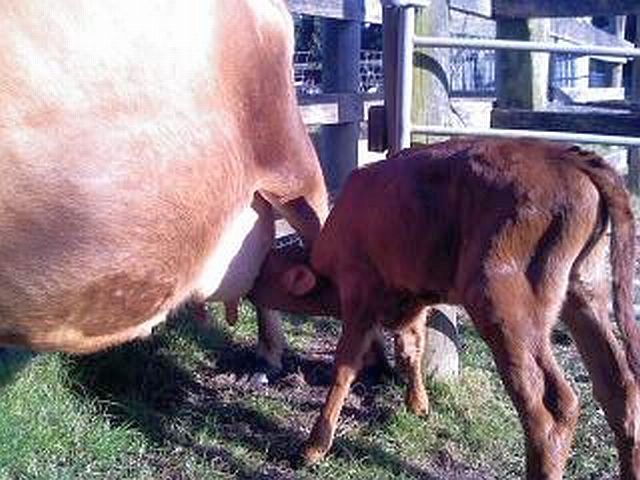
I took a photo of her first session at the milk bar.
Sunday, October 02, 2011
Three dogs and a goat
 |
| Daisy,Lill, Lexie and Baz the goat, enjoying the sun |
As it was a very sunny day, the dogs made the most of it - basking in the sunshine just about all day, and they were joing by Baz the goat who thought that just lounging around was a great idea.
Pansy, the Jersey cow wasn't so impressed!!
Saturday, October 01, 2011
Egg Corp accredits 'free range' farms with 50,000 hens per hectare

It seems unbelieveable, but the Australian Egg Corporation has accredited three farms in New South Wales with outdoor stocking densities of 50,000 hens per hectare, even though the Model Code (to which accredited farms are supposed to adhere) suggests a stocking density of 1500 birds per hectare.
More details on the Free Range Farmers Association website:Wednesday, September 21, 2011
First batch of butter
I made the first batch of butter from Pansy's cream today. 1.5 litres of cream gathered from four milkings yielded 600 grams of butter. And we will have pancakes tonight made with buttermilk. Yum!
In the past I've always used our Cherry Churn to make butter but I cheated today and used the Kenwood Chef- made a bit a mess though. I might go back to using the old churn.It needs a bit of work on one of the paddles - but that won't take long.
 |
| 600 g of unsalted butter ready for packaging |
In the past I've always used our Cherry Churn to make butter but I cheated today and used the Kenwood Chef- made a bit a mess though. I might go back to using the old churn.It needs a bit of work on one of the paddles - but that won't take long.
Tuesday, September 20, 2011
Australian Egg Corp squawking
The Australian Egg Corporation's latest newsletter contains this pathetic appeal:
AECL has been subjected to significant media interest during the past week. AECL urges all egg producers to act in a team-spirited manner as we create some very important policies for the industry. As mentioned earlier, the draft ESA will be open for industry consultation next month.
An AECL statement provided to media about the issue is pasted below.
The Australian Egg Corporation Ltd represents all egg production systems and we are in discussions with egg producers about new egg standards for Australia.
This standard must consider consumer expectations, robust science and commercial reality as it relates to bird health and welfare, food safety and environmental stewardship.
Stocking densities of up to two birds per metre square provide hens with the ability to display all their natural behaviours. They can roam while having access to food, water and shelter in the henhouse. AECL is working to improve the current situation by establishing a cap on free range stocking densities. There is currently no cap on free range stocking densities. his is unacceptable. We believe these changes would be a substantial improvement on the current situation.
We seek this to be legislated and enforced by government.
The egg industry needs to feed a growing population with an affordable source of quality protein. This is our industry’s social responsibility. We believe this
definition will provide clarity, consistency and transparency.
For further information, please contact AECL Communications Manager, Kai Ianssen, on (02) 9409 6909 or kai@aecl.org.
What a load of ....
Here's FRFA's response to James Kellaway, MD of the Egg Corp
'Our members look forward to the planned workshops on your Egg Standards Australia proposal, which we believe will mislead consumers and damage the environmental sustainability of farms. We note your comment:
'This standard must consider consumer expectations, robust science and commercial reality as it relates to bird health and welfare, food safety and environmental stewardship.'
Unfortunately your proposal does not meet consumer expectations or robust science. Despite an assurance by you that details would be provided, you have failed to provide evidence of the methodology of your 'Consumer Survey' and you have shown no evidence that egg production standards anywhere in the world are even close to your proposed high density 'free range' standard.
It is not credible for you to claim that this proposed standard will meet environmental stewardship requirements. The stocking density you propose would ensure that participating farms would be either mud baths or dust bowls - depending on the time of year.'
AECL has been subjected to significant media interest during the past week. AECL urges all egg producers to act in a team-spirited manner as we create some very important policies for the industry. As mentioned earlier, the draft ESA will be open for industry consultation next month.
An AECL statement provided to media about the issue is pasted below.
The Australian Egg Corporation Ltd represents all egg production systems and we are in discussions with egg producers about new egg standards for Australia.
This standard must consider consumer expectations, robust science and commercial reality as it relates to bird health and welfare, food safety and environmental stewardship.
Stocking densities of up to two birds per metre square provide hens with the ability to display all their natural behaviours. They can roam while having access to food, water and shelter in the henhouse. AECL is working to improve the current situation by establishing a cap on free range stocking densities. There is currently no cap on free range stocking densities. his is unacceptable. We believe these changes would be a substantial improvement on the current situation.
We seek this to be legislated and enforced by government.
The egg industry needs to feed a growing population with an affordable source of quality protein. This is our industry’s social responsibility. We believe this
definition will provide clarity, consistency and transparency.
For further information, please contact AECL Communications Manager, Kai Ianssen, on (02) 9409 6909 or kai@aecl.org.
What a load of ....
Here's FRFA's response to James Kellaway, MD of the Egg Corp
'Our members look forward to the planned workshops on your Egg Standards Australia proposal, which we believe will mislead consumers and damage the environmental sustainability of farms. We note your comment:
'This standard must consider consumer expectations, robust science and commercial reality as it relates to bird health and welfare, food safety and environmental stewardship.'
Unfortunately your proposal does not meet consumer expectations or robust science. Despite an assurance by you that details would be provided, you have failed to provide evidence of the methodology of your 'Consumer Survey' and you have shown no evidence that egg production standards anywhere in the world are even close to your proposed high density 'free range' standard.
It is not credible for you to claim that this proposed standard will meet environmental stewardship requirements. The stocking density you propose would ensure that participating farms would be either mud baths or dust bowls - depending on the time of year.'
Monday, September 19, 2011
New house cow to provide all our milk, cream and butter

It's a few years since we had a house on the farm and I've missed making butter and cheese - as well as the taste of real milk!
But now we have Pansy, the Jersey house cow who is giving us around 8 litres a day - so we will have to get a calf to drink some of the milk !!
I'll probably make the first batch of butter tonight or tomorrow.
Thursday, September 15, 2011
Great story on the front page of SMH
It's not often that the egg industry is able to crack the front page of a major metropolitan newspaper, but we've done it this morning in the Sydney Morning Herald.
Have a look at :
http://www.smh.com.au/environment/animals/farmers-cackle-over-freerange-definition-20110914-1k9s9.html
The Australian Egg Corporation must have been dreaming if it thought it could get away with this! The proposed definition would be a total consumer deception and we are confident that the ACCC will jump on them from a great height if it is implemented.
Have a look at :
http://www.smh.com.au/environment/animals/farmers-cackle-over-freerange-definition-20110914-1k9s9.html
The Australian Egg Corporation must have been dreaming if it thought it could get away with this! The proposed definition would be a total consumer deception and we are confident that the ACCC will jump on them from a great height if it is implemented.
Sunday, September 11, 2011
UK study shows benefits of trees in free range paddocks
A UK study about the benefits of trees and shubs in the paddocks where free range hens are allowed to roam found that the problems of feather pecking and cannibalism were reduced significantly. This university study (funded by McDonalds) will help in the argument against the Egg Corporation's intensive 'free range' proposal.
Domestic chickens are descended from the red junglefowl of south-east Asia and are found in areas where there is plenty of undergrowth, and overhead cover, which provides shade, shelter and protection from aerial predators (Johnson 1963; Johnsgard 1986). Horton (2006) found that with tree cover present, a higher proportion of hens in commercial freerange flocks ranged, and ranged further, compared to hens without range tree cover; in ranges with tree cover, the maximum numbers of hens outside were 50 m from the house compared with 10 m in ranges without cover.
Hegelund et al (2005) and Zeltner and Hirt (2008) demonstrated that artificial and tree/bush cover on the range can attract more hens away from the area immediately outside the house compared to ranges without cover, and that the variety and quality of cover was more important than the absolute amount of cover. Furthermore, there is a well-established link between range use and IFP (Injurious Feather Pecking) in commercial layinghen flocks; the higher the percentage of flocks using the outdoor range, the lower the prevalence of feather pecking (Green et al 2000; Bestman & Wagenaar 2003; Nicol et al 2003; Lambton et al 2010). In an experimental study by Mahboub et al (2004), a negative correlation was found between percent of time spent outside and plumage damage .
If providing cover on the range improves the number and distribution of hens using the range, and range use is negatively correlated with IFP, it might also be expected that range cover will be correlated with IFP. To our knowledge, however, the relationship between proportion of range cover or canopy cover and IFP has yet to be examined.
The study described the first results from an ongoing collaborative project between a major UK high street restaurant chain and two UK egg-producing companies, McDonald’s Restaurants Ltd, UK (McDonald’s), The Lakes Free Range Egg Co Ltd and Noble Foods Ltd. The aim of the project was to implement animal welfare research on a commercial scale and improve the welfare of laying hens within the McDonald’s supply chain. During 2007 and early 2008, all 286 laying hen producers (approximately one third are Lakes and two-thirds are Noble), were required by McDonald’s to plant, if not present already, 5% of the total range area in trees (decided upon after consultation of existing farm assurance free-range standards, cost and practical considerations). There was a large variation in tree cover because of the proportion of the range on which producers decided to plant trees, the timing of planting prior to flock placements and the presence of existing tree stands.
The objective of this study was to investigate, in a commercial situation, the correlation between: i) proportion of range cover and ii) proportion of canopy cover, with plumage damage of end-of-lay hens.
The full report is available from Universities Federation for Animal Welfare
The Old School, Brewhouse Hill, Wheathampstead,Hertfordshire AL4 8AN, UK
or by contacting us at Freeranger Eggs
Friday, September 09, 2011
ACCC acts on 'roaming' chickens
Major meat chicken suppliers in Victoria are facing court for allegedly claiming their chooks roam freely in spacious barns.
The Australian Competition and Consumer Commission has launched Federal Court action against Baiada Poultry and Bartter Enterprises and Turi Foods, which supply chickens to Steggles and La Ionica respectively, and peak industry body the Australian Chicken Meat Federation Inc.
All three are accused of claiming their chickens have been raised in spacious barns where they can roam freely, similar to free-range birds.
If the action is successful, it will send a great message to all those intensive 'free range' egg producers who are making a fortune out of gullible consumers and slack regulations.
The consumer watchdog claims chickens raised in barns cannot enjoy a free range-type lifestyle because there are so many of them.
"Promotional activities that convey an impression of farming practices are powerful representations which influence many consumer purchases and food choices," the ACCC says.
The Australian Competition and Consumer Commission has launched Federal Court action against Baiada Poultry and Bartter Enterprises and Turi Foods, which supply chickens to Steggles and La Ionica respectively, and peak industry body the Australian Chicken Meat Federation Inc.
All three are accused of claiming their chickens have been raised in spacious barns where they can roam freely, similar to free-range birds.
If the action is successful, it will send a great message to all those intensive 'free range' egg producers who are making a fortune out of gullible consumers and slack regulations.
The consumer watchdog claims chickens raised in barns cannot enjoy a free range-type lifestyle because there are so many of them.
"Promotional activities that convey an impression of farming practices are powerful representations which influence many consumer purchases and food choices," the ACCC says.
Friday, September 02, 2011
Today Tonight runs bodgy egg research findings
The lightweight 'news' and magazine TV programme, Today Tonight ran a piece about US researchers claiming to demonstrate that there is no nutritional difference between free range and cage laid eggs.
Of course the study undertaken by North Carolina State University showed there was no difference. The research was funded by the egg industry and the hens used were all beak trimmed.
The 'free range' hens used in the research programme may have been allowed access to the outdoors, but as their beaks were trimmed, they essentially could only eat the same grains and food which were available to the birds in cages. They had great difficulty eating grass, or picking up worms, spiders etc without a full beak.
TV shows like this just perpetuate the myth that 'an egg is an egg'.
Have a look at:
http://au.news.yahoo.com/today-tonight/video/watch/26473133/
Of course the study undertaken by North Carolina State University showed there was no difference. The research was funded by the egg industry and the hens used were all beak trimmed.
The 'free range' hens used in the research programme may have been allowed access to the outdoors, but as their beaks were trimmed, they essentially could only eat the same grains and food which were available to the birds in cages. They had great difficulty eating grass, or picking up worms, spiders etc without a full beak.
TV shows like this just perpetuate the myth that 'an egg is an egg'.
Have a look at:
http://au.news.yahoo.com/today-tonight/video/watch/26473133/
Friday, August 26, 2011
Trees are beneficial for free range hens
There's been some research in the UK (paid for by McDonalds) which says that tree cover in paddocks is beneficial for free range hens.
Well bless me! I've known that for around 50 years and I reckon that knowledge has been around for 'a while' before that.
But of course no-one takes any notice until there's a research paper by academics which someone has paid for!
What a load of cobblers. Anyway the link is :
http://www.ufaw.org.uk/documents/BRIGHT.pdf
Well bless me! I've known that for around 50 years and I reckon that knowledge has been around for 'a while' before that.
But of course no-one takes any notice until there's a research paper by academics which someone has paid for!
What a load of cobblers. Anyway the link is :
http://www.ufaw.org.uk/documents/BRIGHT.pdf
Tuesday, August 23, 2011
New flock just starting to lay

It means that we will have pullets eggs for the Churchill Island Farmers' Market this Saturday..
Lexie is the Maremma charged with looking after them and she is doing a top job.
I've had to rig up a light in the shed which I turn on just before dusk so all the chooks can see to perch - then when they have all settled, it can be turned off. Some flocks need a bit of light to see what they are supposed to do - but some happily jump in the sheds in the late afternoon and find their own perch. It largely depends on the time of year. Extended evening daylight gives them plenty of time, but we need to give the youngesters a bit of help at this time of year.
Friday, August 12, 2011
New website in action
Our new Freeranger Eggs website is now live at www.freeranger.com.au I spent a couple of months getting things organised and I revamped the website of the Free Range Farmers Association at the same time.
Have a look at www.freerangefarmers.com.au and tell me what you think.
Have a look at www.freerangefarmers.com.au and tell me what you think.
Friday, August 05, 2011
Goodbye Chicca
 |
| Chicca loved the sheep trough on hot days |
Rather than a skin infection and a urinary tract infection, which was the original veterinary diagnosis, the underlying problem was an aggressive mammary cancer.
Rather than put her through more pain, we had to make the ultimate decision.
 |
| This was the first meeting between Chicca and Berkley (our Maremma who died in March) |
Monday, August 01, 2011
NSW Greens introduce their Truth in Labelling Bill
Louise Hall wrote this article in today's Sydney Morning Herald:
THE NSW Greens will introduce legislation into the NSW Parliament this week to create a labelling scheme for caged, barn and free range eggs.
Egg producers will be allowed to label their cartons free range only if there is no more than 750 laying fowl per hectare. Water, shade and shelter must also be provided and beak trimming is prohibited under the Truth in Labelling (Free-Range Eggs) Bill.
Eggs that are not free range or barn must be labelled as cage eggs. The use of advertising or packaging that suggests the laying fowl are not kept in cages would be prohibited.
Corporations would face fines of up to $55,000. Individuals could receive six months’ jail and a $5500 fine.
The Greens MP John Kaye said people were being ripped off by unscrupulous caged egg producers, and legitimate free range producers were unable to compete. He said the absence of legislated definitions and enforceable penalties for false labelling meant in some cases free range "is nothing more than a marketing exercise to boost sales and prices".
The ACT and Tasmania have passed legislation to regulate the production and labelling of eggs.
The industry body, the Australian Egg Corporation, said the cap on stocking densities in the draft bill is "unsustainable and unrealistic".
AECL, dominated by Australia’s three largest egg producers, says it will lobby NSW MPs to vote against the bill.
With the Egg Corporation lobbying hard against it, the Bill will have an uphill battle. Hopefully thee will be a groundswell of support to let the MP's realise that the provisions in the Bill are very sustainable and realistic.
Egg producers will be allowed to label their cartons free range only if there is no more than 750 laying fowl per hectare. Water, shade and shelter must also be provided and beak trimming is prohibited under the Truth in Labelling (Free-Range Eggs) Bill.
Eggs that are not free range or barn must be labelled as cage eggs. The use of advertising or packaging that suggests the laying fowl are not kept in cages would be prohibited.
Corporations would face fines of up to $55,000. Individuals could receive six months’ jail and a $5500 fine.
The Greens MP John Kaye said people were being ripped off by unscrupulous caged egg producers, and legitimate free range producers were unable to compete. He said the absence of legislated definitions and enforceable penalties for false labelling meant in some cases free range "is nothing more than a marketing exercise to boost sales and prices".
The ACT and Tasmania have passed legislation to regulate the production and labelling of eggs.
The industry body, the Australian Egg Corporation, said the cap on stocking densities in the draft bill is "unsustainable and unrealistic".
AECL, dominated by Australia’s three largest egg producers, says it will lobby NSW MPs to vote against the bill.
With the Egg Corporation lobbying hard against it, the Bill will have an uphill battle. Hopefully thee will be a groundswell of support to let the MP's realise that the provisions in the Bill are very sustainable and realistic.
Many commercial free range egg farms are operating with those standards already in place all over Australia. Members of associations affiliated with the Free Range Egg and Poultry Association of Australia meet those requirements which are recognised by consumers as satisfying their 'free range' expectations.
The Australian Egg Corporation of course wants a plan which allows intensive farming operations to be classified as 'free range' and allow up to 20,000 chickens per hectare and the beak trimming of birds to be accepted as 'normal'.
Saturday, July 30, 2011
The argument for a national definition of 'free range'
There is now a broad agreement in the Australian egg industry that clear, legal definitions need to be established for different methods of production.
Currently, many producers who label their eggs as 'free range' run stocking densities well above the 1500 bird limit. AECL has revealed that some farms run as many as 40,000 chickens per hectare.
A national definition for free range egg production is firmly on the agenda and submissions are being made to the Federal Government to implement a standard.
The Free Range Farmers Association in Victoria and the national industry body, Free Range Egg and Poultry Association of Australia have been pushing for many years that a national definition should be established for free range production systems which meets consumer expectations.
These arguments have been boosted by the Australian Egg Corporation's managing director, James Kellaway, who has called for the definitions of egg-production processes to be enshrined in law. He said: “We have definitions that are enforced by the industry but we want to make such definitions more robust and definitive … what we'd like to see is a definition that is clearly enunciated and enforced”
The Free Range Egg and Poultry Association of Australia Inc. welcomes that announcement and has again written to the Minister for Agriculture, Senator Joe Ludwig, re-opening the debate for the development of a clear definition for free range egg production.
The Association has argued that the starting point should be the Model Code of Practice for the Welfare of Animals – Domestic Poultry. The definition should require a maximum outdoor stocking density of 1500 hens per hectare and prohibit the beak trimming or de-beaking of birds.
Currently, many producers who label their eggs as 'free range' run stocking densities well above the 1500 bird limit. AECL has revealed that some farms run as many as 40,000 chickens per hectare.
The Model Code requires producers to find alternative measures to combat feather pecking and cannibalism before resorting to beak trimming – but most farms (even those which claim to be free range) make no attempt to find alternatives. Their birds are beaked trimmed at day old or soon after.
The Australian Egg Corporation is currently trying to implement a new standard for a version of free range production that will allow a stocking density of up to 20,000 birds per hectare and will allow beak trimming as a matter of course.
Many successful commercial egg farms have demonstrated that beak trimming is totally unnecessary for hens on a free range farm – unless the farm is over stocked.
We agree with the Australian Egg Corp (for a change)
James Kellaway, managing director of the Australian Egg Corporation is quoted in The Age newspaper today as saying that definitions of egg-production processes should be enshrined in law. “We have definitions that are enforced by the industry but we want to make such definitions more robust and definitive … what we'd like to see is a definition that is clearly enunciated and enforced”.
That's exactly what we have been saying about the problems consumers have with the lack of a real definition of the term 'free range'.
It's great that at last the Egg Corp has come to the same realisation and hopefully they will help to push the Federal Government into making a decision!
The Free Range Farmers Association and the Free Range Egg and Poultry Association of Australia have been trying to get the Minister for Agriculture, (currently Senator Joe Ludwig) to take a serious look at introducing a real definition for 'free range'. So far successive Ministers have ignored us - but with the Egg Corporation also pushing we just might get somewhere.
That's exactly what we have been saying about the problems consumers have with the lack of a real definition of the term 'free range'.
It's great that at last the Egg Corp has come to the same realisation and hopefully they will help to push the Federal Government into making a decision!
The Free Range Farmers Association and the Free Range Egg and Poultry Association of Australia have been trying to get the Minister for Agriculture, (currently Senator Joe Ludwig) to take a serious look at introducing a real definition for 'free range'. So far successive Ministers have ignored us - but with the Egg Corporation also pushing we just might get somewhere.
Sunday, July 24, 2011
Carbon Tax - what real benefit?

A full emissions trading scheme will then be implemented, allowing the market to set the carbon price.
Allowances and assistance will be made for a number of industries, particularly those heavy on industrial activities such as steel, aluminium, cement and zinc producers, and some manufacturers. A carbon price will not apply to fuel for off‐road and on‐road light transport used by the agriculture, forestry and fisheries industries. Households and small business will also be exempt from a carbon price on fuel.
The Government has committed to boosting its 2050 emissions reduction target from 60 percent to 80 percent. It is also targeting a reduction of between 5 and 25 per cent by 2020 (depending on the level of international action).
Taxing these top 500 companies does have implications for small businesses. An increased price for products and services because of the cost of the carbon tax will be passed on.
As a small agricultural business, we won't be directly subject to the tax, but we will obviously pay through increased electricity prices etc. etc. etc.
We still have not heard from the Government how our carbon positive type of production will be taken into account. Why should we be slugged just as hard as any other business which has taken no steps to reduce its carbon footprint?
Friday, July 15, 2011
Great day for a new lamb!
 Our first Suffolk lamb for the season was born today - and what a great day it was. Sun and no wind. Tonight is cold but at least there's no rain and no wind!
We have just bought an understudy for Manola - six month old Tora who is getting used to the farm and bonding with our Suffolk/Dorper ram lamb
 |
| First drink |
Thursday, July 14, 2011
Free Ranger iphone game
The UK's Noble Foods, which has the brand Happy Egg Company has launched an iphone 'Free Ranger' game to promote its sales.
http://itunes.apple.com/us/app/free-ranger/id441507717?mt=8
Is this the shape of things to come?
http://itunes.apple.com/us/app/free-ranger/id441507717?mt=8
Is this the shape of things to come?
Tuesday, July 12, 2011
Chicca's skin infection

She doesn't like it and thinks I am an evil person for restricting her like this - but we hope it will only be for a couple of weeks.
She's on anti-biotics twice a day and an anti-inflammatory tablet once or sometimes twice a day.
Monday, July 11, 2011
Will the Australian carbon tax work?

The long-awaited carbon tax announcement by the Australian Government looks like a bit of a fizzer to me.
It seems pretty pointless to introduce a tax and then compensate virtually everyone for the extra costs they will face – when the purpose is supposed to be to change behaviour and reduce greenhouse gas emissions.
If no-one feels any pain, where is the incentive for people to cut down on their use of petrol, diesel, electricity and all the other pollutants which have become an automatic part of their lives.
On the farm we have reduced our carbon footprint by restricting our delivery policy to within one hour of the farm, using manual production methods (rather than collecting eggs via electricity-driven belts etc.) and maintaining native vegetation on the property.
I don't understand what benefits in terms of a reduction in carbon dioxide emissions the Australian Government expects from a tax which doesn't encourage end users to modify their behaviour.
State Governments seem to understand that the simplest and most effective way to cut down on the use of water is to double the price.
Should be the same with electricity – that will make it more cost-effective to install solar and wind plants – and fuel to cut down on the use of hydro-carbons.
Sunday, July 03, 2011
Ag Minister under fire (and he should be)
The Federal Minister for Agriculture, Senator Joe Ludwig, must be a strange bloke. His knee-jerk reaction to ban live cattle exports to Indonesia once massive publicity hit about the treatment of cattle in that country's abattoirs doesn't really sit with his complete indifference to the scams in the egg industry.
It is even worse that the blanket ban on live exports includes Elders whuch has been operating its own state-of-the-art abattoir in Indonesia for some years. It meets all Australian standards and yet it is not allowed to send cattle there!
Whether or not the live cattle trade should be allowed at all is a separate question. There is much to be said for value-adding here in Australia and re-opening abattoirs in the Northern Territory and Northern Queensland which were forced to close once live exports took off. Interestingly advertisements have just been placed in major newspapers for staff needed at a huge new meat processing facility to be set up in Darwin
But, back to the Minister. If you can act so swiftly Senator Ludwig, why not get off your backside and do something about the eggs in Australia which are labelled as 'free range' when most of them are produced on intensive farms with hens that have been de-beaked (or beak trimmed).
It is even worse that the blanket ban on live exports includes Elders whuch has been operating its own state-of-the-art abattoir in Indonesia for some years. It meets all Australian standards and yet it is not allowed to send cattle there!
Whether or not the live cattle trade should be allowed at all is a separate question. There is much to be said for value-adding here in Australia and re-opening abattoirs in the Northern Territory and Northern Queensland which were forced to close once live exports took off. Interestingly advertisements have just been placed in major newspapers for staff needed at a huge new meat processing facility to be set up in Darwin
But, back to the Minister. If you can act so swiftly Senator Ludwig, why not get off your backside and do something about the eggs in Australia which are labelled as 'free range' when most of them are produced on intensive farms with hens that have been de-beaked (or beak trimmed).
Subscribe to:
Posts (Atom)
